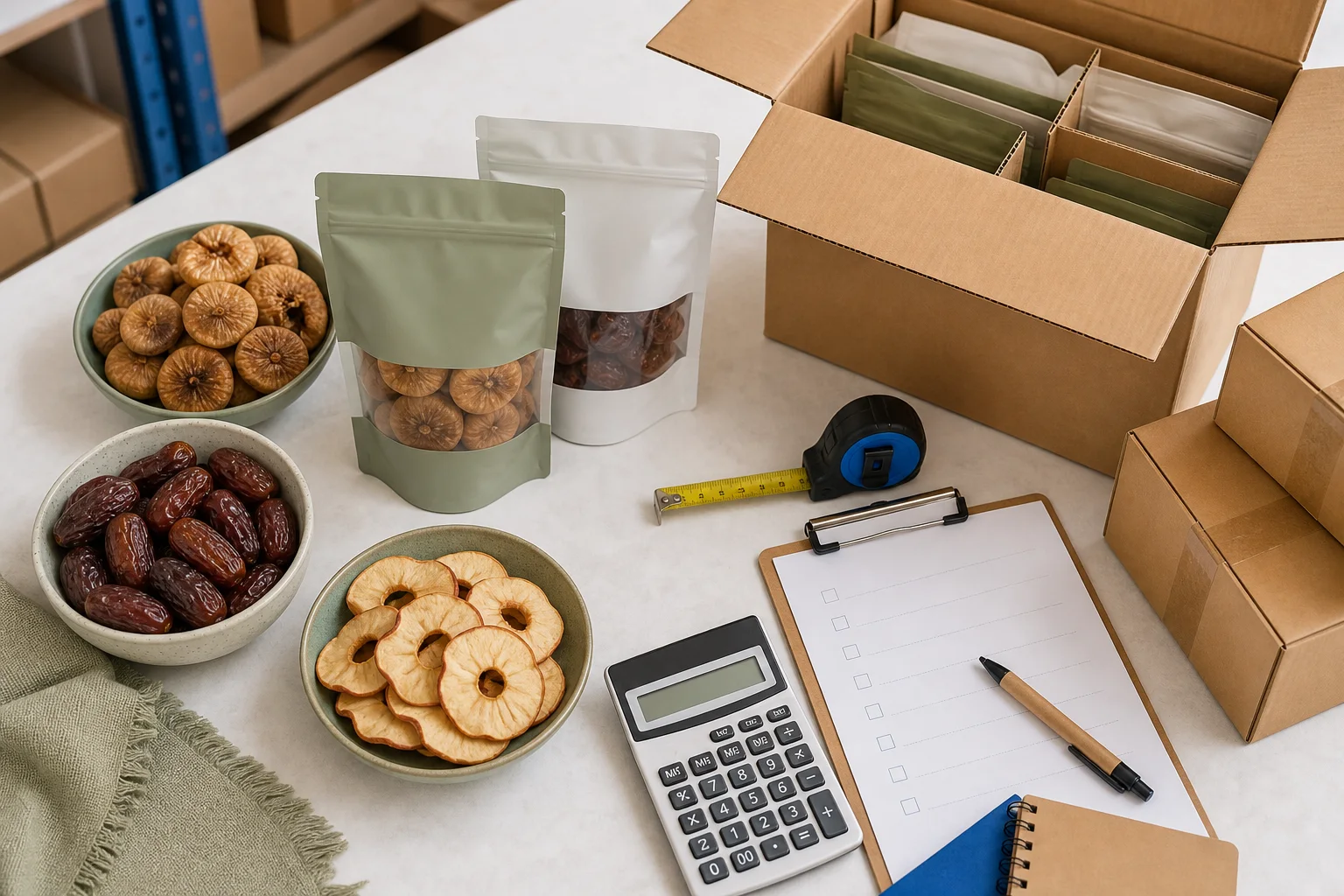
A wholesale dried fruit order should not be judged by the supplier's unit price alone. The number that matters for a retailer or importer is the landed cost of one sellable retail unit, followed by the margin that remains after the product reaches the shelf.
This guide gives buyers a simple way to plan a first order before asking for a final quotation. It is an operating framework, not a customs or tax calculation. Freight, duties, inspection fees, and local compliance costs vary by destination, so confirm the final numbers with your freight forwarder, customs broker, and local advisor.
1. Start with one sellable unit
The easiest way to make a first-order calculation useful is to choose one sellable unit as the base. That might be a 100g retail pouch, a 250g resealable pouch, a 500g family pack, or one gift box.
Do not begin with only the price per kilogram. A kilogram price is useful for comparing suppliers, but it does not tell you what one finished pouch will cost after packaging, cartons, freight, and local handling are included.
For each SKU, record:
- net weight per retail unit
- units per carton
- cartons in the first order
- product price per kilogram or per unit
- packaging format and whether it is standard or custom
- target destination and delivery term
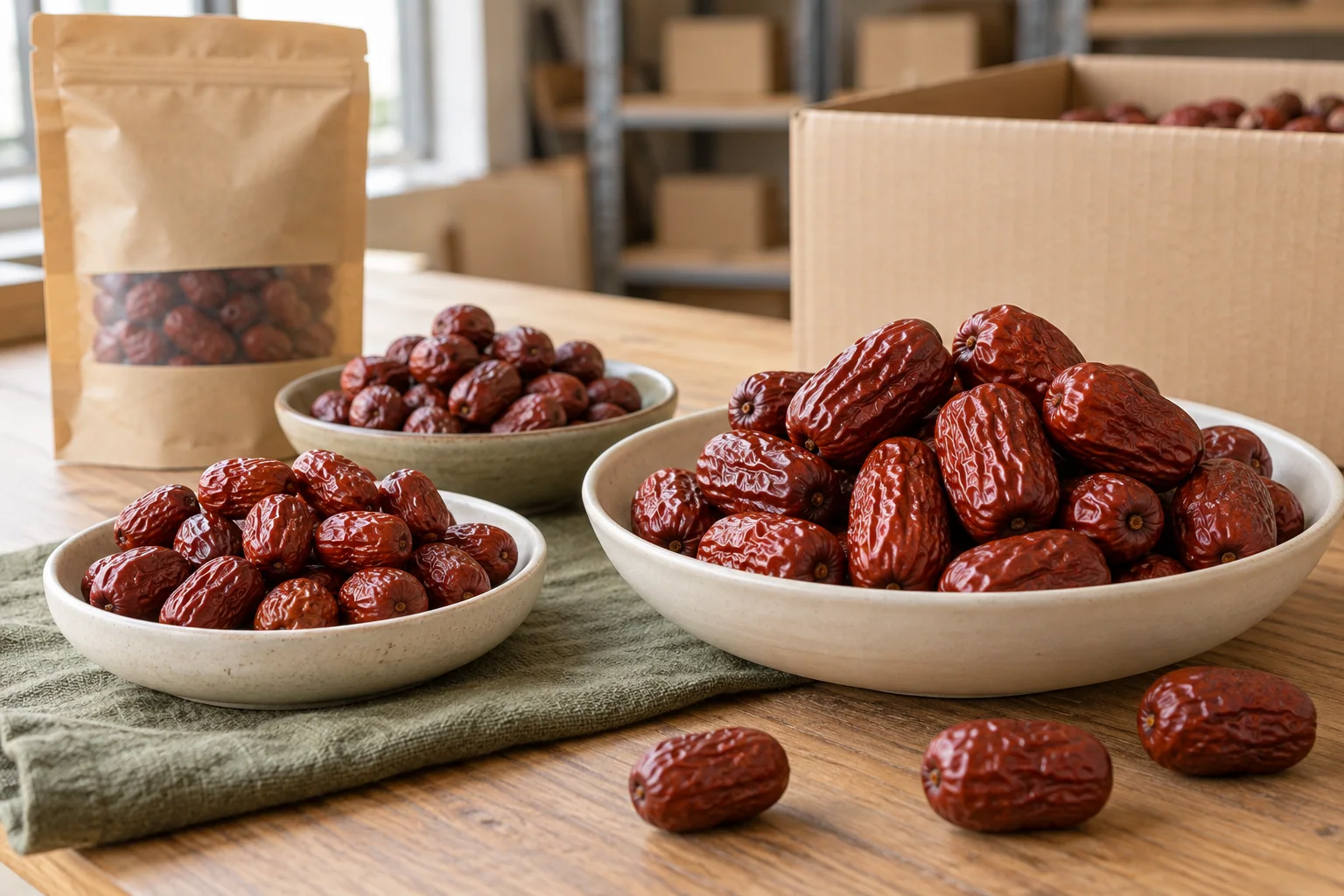
For example, Dried Figs and Dried Dates may have different product prices, but the bigger difference in the final shelf cost can come from pack weight, carton efficiency, and packaging requirements.
2. Separate the product cost from the packaging cost
The first calculation should separate what is inside the pouch from the pouch itself. This makes it easier to compare a standard pack with a private label project.
| Cost item | What to confirm with the supplier |
|---|---|
| Product | Grade, size, cut, moisture condition, and price basis |
| Inner packaging | Pouch, tray, jar, or box; material and barrier requirement |
| Label | Sticker label, printed pouch, bilingual label, barcode, and artwork setup |
| Outer carton | Units per carton, carton strength, dimensions, and gross weight |
| Packing labor | Whether filling, sealing, labeling, and carton packing are included |
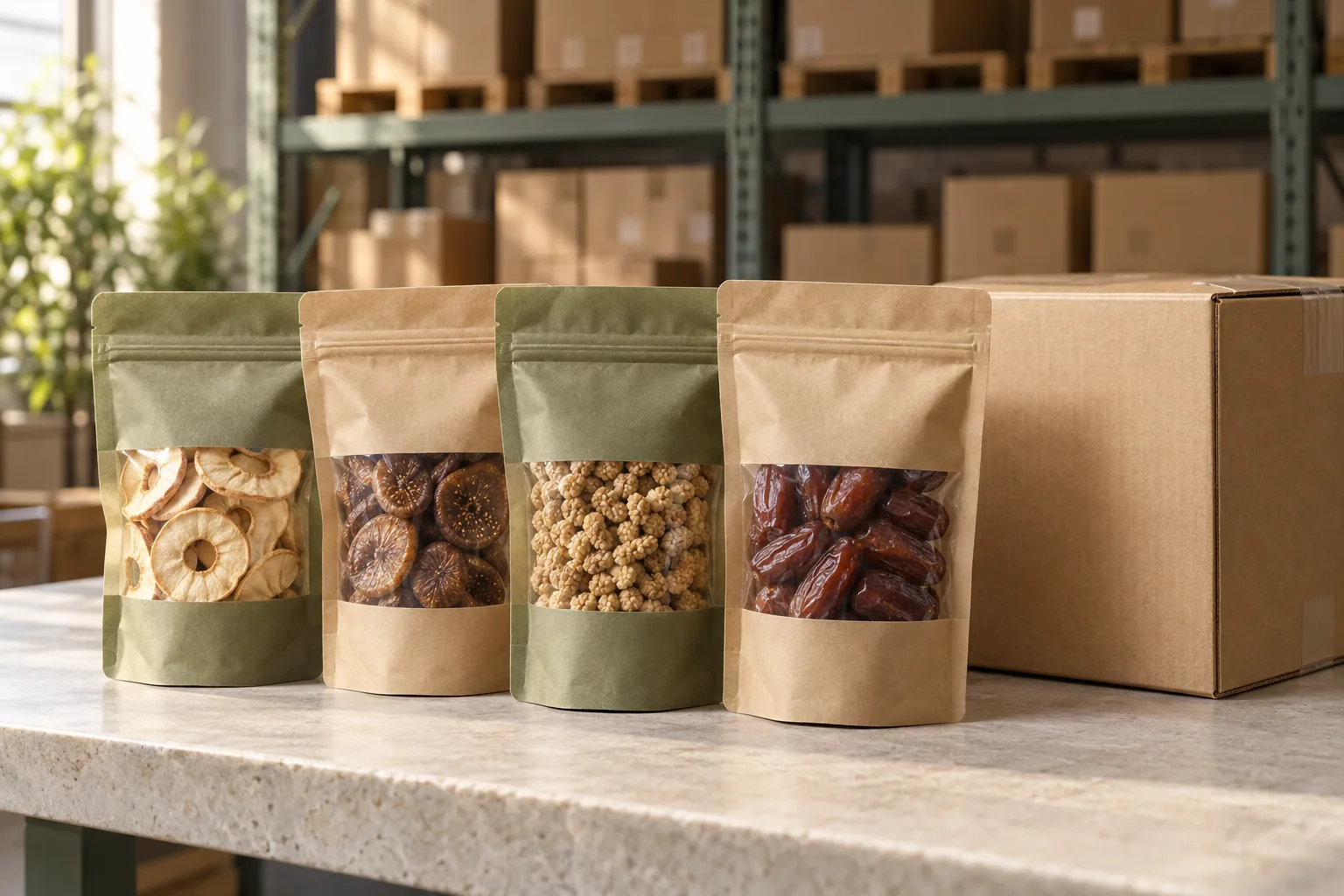
Standard unbranded pouches are usually easier for a market test because the buyer can confirm product demand before investing in printed packaging. A custom printed pouch or gift box may make sense after the SKU, pack size, and reorder signal are clearer.
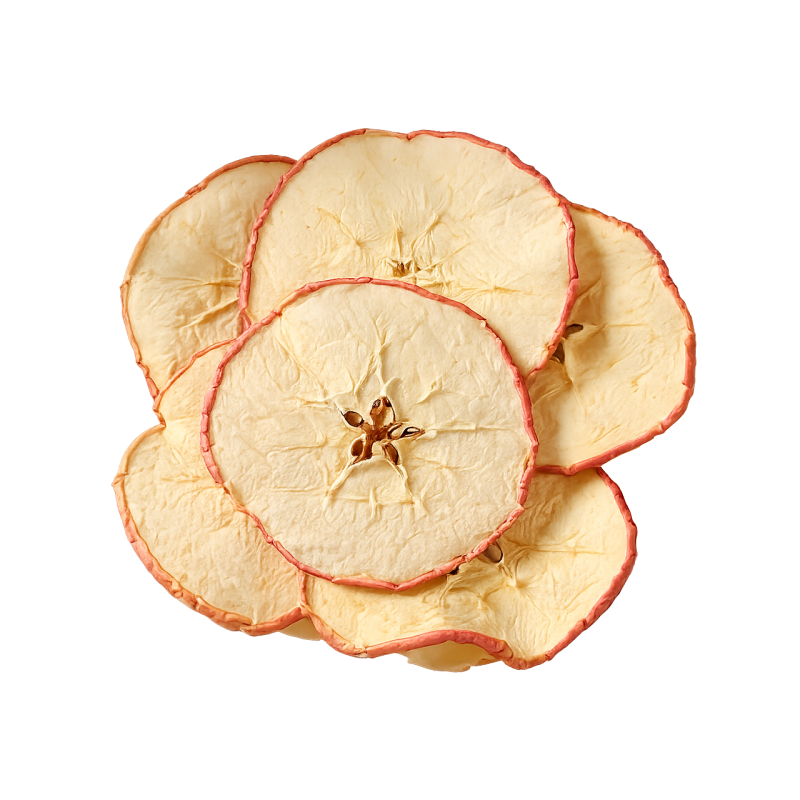
If your project includes Dried Apple Slices, for example, confirm whether the product needs a larger pouch because of piece size or a stronger moisture barrier because of the target shelf life. Packaging is part of the product economics, not just a design decision.
3. Calculate the true landed cost
For a first planning model, use this structure:
Landed cost per retail unit = product cost + retail packaging + label and packing cost + freight allocation + import and destination allowance
The last item should be treated as an allowance until your destination costs are confirmed. Depending on the market, it may include customs duty, broker fee, inspection, port handling, local delivery, warehouse receiving, and payment or currency costs.
To allocate freight correctly, do not divide the total freight bill only by the number of cartons if the cartons contain different quantities. Use the number of sellable units:
Freight allocation per unit = total allocated freight and destination cost / total sellable retail units
This is particularly important when comparing a 100g trial pouch with a 500g family pouch or a gift box. A larger pack may have a higher price per unit but a lower packaging and freight cost per kilogram.
4. Use an illustrative example before requesting a quote
The following example is for planning only and is not a quotation:
| Item | Example cost per 250g pouch |
|---|---|
| Dried fruit product | $2.40 |
| Retail pouch and label | $0.35 |
| Filling, packing, and carton allocation | $0.20 |
| Freight and destination allowance | $0.45 |
| Estimated landed cost | $3.40 |
If the planned retail price is $6.99, the indicative gross margin before retailer overhead, promotion, payment fees, and shrinkage is:
($6.99 - $3.40) / $6.99 = 51.4%
The point of this exercise is not to predict the final margin precisely. It is to identify which variable needs attention. If the margin is too low, the solution may be a different pack size, a simpler label, a more efficient carton, a different shipping term, or a different product mix. Raising the retail price is only one option.
5. Compare 20-carton, 50-carton, and 100-carton scenarios
The first order should be planned around the number of sellable units and the cost behavior at each volume. A small trial may carry a higher freight allocation and a higher packaging setup cost per unit. A larger order may lower the average cost, but it also increases inventory risk.
For each volume, compare:
- total cash required before shipment
- total sellable units
- landed cost per unit
- expected retail revenue
- expected gross profit before overhead
- months of inventory at the expected sales rate
- cash tied up if one SKU sells more slowly than planned
A useful first assortment often has three roles:
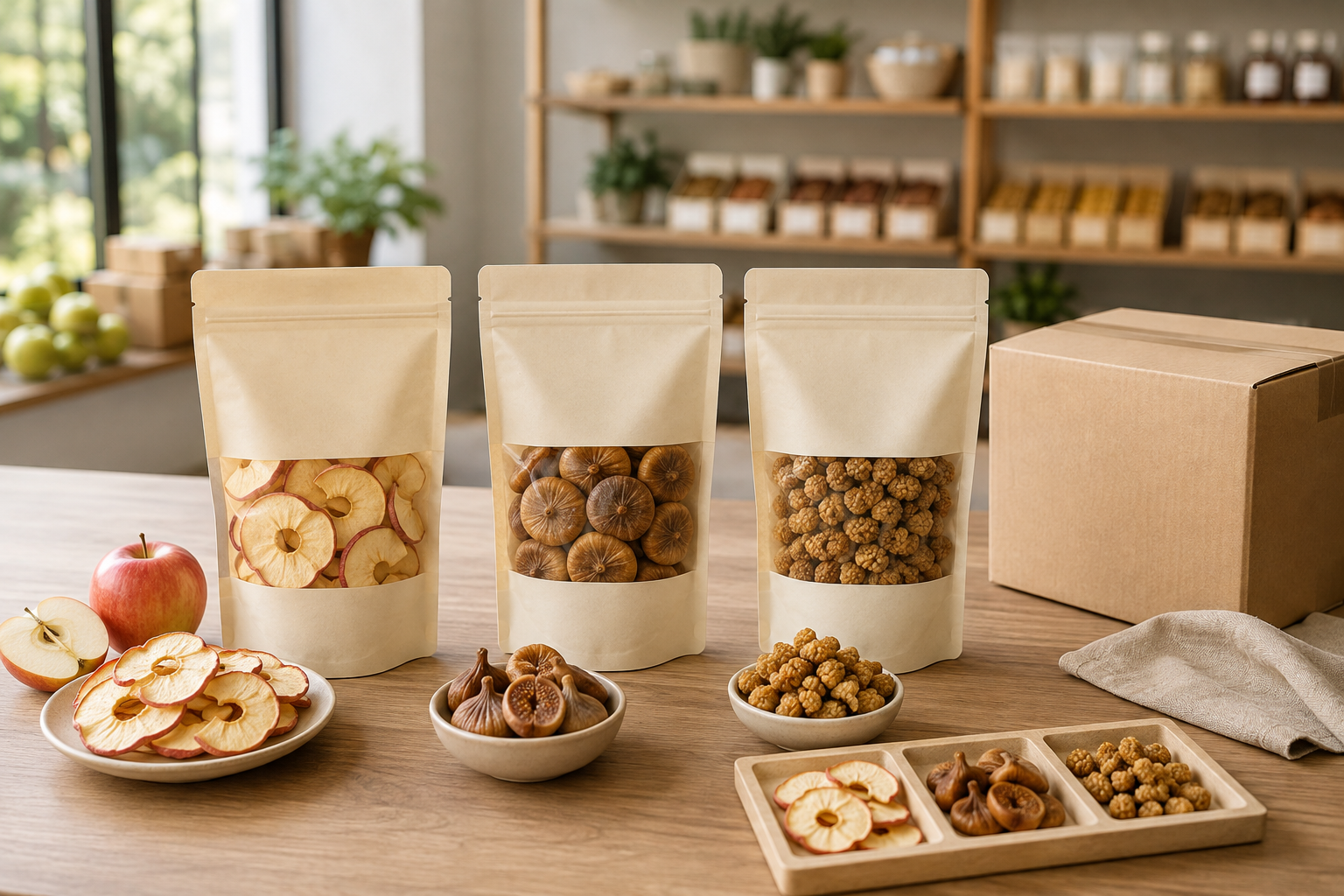
- one familiar everyday dried fruit, such as dates or figs
- one easy-entry snack SKU, such as apple slices
- one higher-value presentation item, such as a Dried Fruit Gift Box
This gives the buyer multiple price points without requiring a large number of untested products. The right mix depends on the destination market, channel, and packaging plan.
6. Work backward from the target margin
Before you ask for a price, define the margin you need. A retailer, distributor, and importer may each use a different margin structure, so the same product can require a different landed cost target in each channel.
Use this simple reverse calculation:
Maximum landed cost = target retail price × (1 - target gross margin)
If the planned retail price is $7.99 and the target gross margin is 45%, the maximum target landed cost is:
$7.99 × (1 - 45%) = $4.39
That $4.39 is not automatically the supplier's product price. It must cover the finished product, packaging, freight, destination costs, and any other costs included in your model. This distinction helps prevent a common mistake: accepting a low factory price that becomes unprofitable after shipping and retail preparation.
7. Confirm these numbers in the supplier quotation
Ask the supplier to state the following items clearly rather than sending only one combined unit price:
- Product price basis and specification
- Net weight and tolerance per retail unit
- Units per carton and carton dimensions
- Standard or custom packaging cost
- Label, barcode, and artwork setup cost
- Production or packing lead time
- MOQ by SKU and whether mixed cartons are possible
- Incoterm and what the quoted freight includes
- Sample cost and whether it can be credited against a bulk order
- Documents available for the destination market
For a quote request, you can send the target market, product list, pack size, expected first-order quantity, packaging preference, destination port or city, and whether you need private label. This gives the supplier enough context to return a useful order model.
Conclusion
The best first-order calculation is not the most complicated spreadsheet. It is a clear model that connects one sellable unit to the total order, the destination cost, and the retail price.
Start with a small assortment, separate product cost from packaging, allocate freight by sellable unit, and work backward from the margin you need. Once the numbers are clear, you can decide whether to improve the pack size, simplify the packaging, increase the order volume, or change the SKU mix.
Browse our dried fruit catalog or send a wholesale inquiry with your target market, pack size, and expected order quantity. We can help confirm product options, packaging, MOQ, and shipping terms for the first order.
 Related products